Date Seal - A chain of self-verifiable stamps and local-first, mini-blockchain for document integrity as simple as Copy-Paste
By Josh Spooner, the last date scientist, and many giants Published in August 2024
Satoshi Nakamoto
In the digital realm, a visionary’s spark ignited, Satoshi’s genius, both in code and narrative, united. A chain of trust, decentralized and bright, your legacy forever recited.
Abstract. We propose and demo Date Seal, a protocol that provides human-verifiable proof that a content block existed at a specific point in time, as easy to use as copy-paste. This local-first, tamper-proof, and self-verifiable document format empowers billions of people with cost-effective, trustworthy, tamper-verifiable record-keeping standards and dynamic accounting ledgers. By standardizing the content normalization, digestion, time-stamping, and updating of content blocks with canonical, content-addressable references, Date Seal bridges a major gap between smart contracts and human-readable Ricardian contracts. The protocol addresses privacy concerns by allowing authors to control the inclusion of personal identifiers while separating out formatting contributions from designers, while AI can assists non-technical users in verifying the technical implementation. Date Seal’s portability and peer-to-peer nature pave the way for multi-chain, multi-party Ricardian contracts, revolutionizing how we establish trust in digital documents. 1
Introduction
The internet’s data ecosystem has become heavily reliant on centralized cloud platforms and crypto platforms, both of which have limitations in terms of offline accessibility, internet outage resilience, and decentralized trust. While these systems function adequately for most users, they inherently suffer from the weaknesses associated with centralized trust models. [^ds/4c505242f768/2024-08-24^]
What the digital world needs is a paradigm shift: a human and machine-readable, portable document standard that relies on cryptographic proof rather than centralized trust. This standard should enable any two willing parties to directly verify “date-sealed” smart documents without the need for a trusted intermediary. Enter Date Seal - an in-line and archived document stamp that provides a cryptographic proof of a content block’s existence at a specific point in time.
In this paper, we introduce Date Seal as a solution to the document verifiability and agentic identity problem. Our approach utilizes a peer-to-peer distributed system to generate computational proof of the chronological order of date seal stamps. This system allows for optional redaction of identifying information, ensuring privacy where needed. The security of this system is maintained as long as honest nodes sync periodically and collectively maintain the longest sequence of cross-verified date-sealed blocks, outpacing any potential group of attacker nodes.
By leveraging the power of cryptographic proofs and decentralized verification, Date Seal aims to revolutionize how we establish trust in digital documents, paving the way for more secure, transparent, and user-controlled data management in the digital age.
Date Sealing
Date-Sealing is the core process of the Date Seal protocol, consisting of several key components that work together to create a verifiable, time-stamped record of content. Let’s explore each of these commands and components in detail:
- Digest Command
- Seal
- Publish to Obsidian or NOSTR
- Add external link to 🛡️
- Copy-Check Command
- Usability and UX
Digest Command
Content Block Definition
A content block is a discrete unit of information that can be individually referenced, sealed, and verified. It is typically defined as a continuous section of text that serves a specific purpose or conveys a particular idea. It can be as small as a single line or as large as multiple paragraphs, depending on the content’s logical structure. Here are some key characteristics of markdown content blocks:
- Structural Boundaries: Content blocks are often delineated by structural elements in markdown, such as:
- Headers (e.g.,
# Header 1,## Header 2) - Blank lines separating paragraphs
- List items (bulleted or numbered)
- Code blocks (fenced or indented)
- Callouts (toggle-able)
- Blockquotes
- Headers (e.g.,
- Semantic Unity: A content block should represent a cohesive unit of information. This could be a single concept, a step in a process, or a self-contained piece of data.
- Markless Format:.The ability to extract the core content by removing markdown syntax is crucial for content blocks. This process, say “markless formatting”:
- Retains words and key punctuation while stripping away formatting elements.
- Enables visual reformatting of content blocks without altering their semantic meaning.
- Facilitates consistent hashing and comparison of content, regardless of markdown styling.
- Allows for flexible display options while maintaining the integrity of the content’s essence.
- Supports interoperability between different markdown-based systems or platforms.
- Granularity: The size of a content block can vary based on the document’s needs. Smaller blocks allow for more precise referencing and sealing, while larger blocks maintain context.
- Nestability: Content blocks can be nested within each other. For example, a list item might contain multiple paragraphs, each of which could be considered a sub-block.
- Metadata Inclusion: In some cases, a content block might include its own metadata, such as tags, categories, or internal references.
Digest Content Blocks
The first step in Date-Sealing is to create a unique cryptographic hash of the content block. This is achieved using the SHA-256 hashing algorithm, which produces a fixed-size output regardless of the input size. To make the hash more manageable and user-friendly, we shorten the 64-character SHA-256 hash output to its first 12 characters as a digest - a balance between uniqueness and brevity.
- [#] SHA-256 Demo
Markdown Links - Local and Web
Date Seal leverages various types of Markdown links to create a robust system of references and embeds, supporting both local and web-based content. This flexibility allows for a seamless integration of internal documents and external resources. The following table outlines the various link types, demonstrating their syntax, purpose, and providing examples to illustrate their usage in both local and web contexts:
| Link Type | Syntax | Purpose | Example |
|---|---|---|---|
| Internal Link | [[]] | Links to another note within the system | [[Project Overview]] |
| Embed | ![[ ]] | Embeds content from another note or media file | ![[Monthly Report.pdf]] |
| Block Reference | [[\#^]] | Links to a specific block or heading in another note | [[Meeting Notes\#^action-items]] |
| Footnote Reference | [^] | Creates a reference to a footnote | This is a fact[^1] |
| Block ID | ^ | Assigns a unique identifier to a block of content | This is an important point^key-concept |
| Image Link |  | Embeds an image from the web |  |
| Standard Web Link | [text](URL) | Creates a clickable link to a web page | [WikiWe](https://www.wikiwe.org) |
| The ability to seamlessly integrate local and web-based content through these various link types enhances the versatility of Date Seal. It allows users to create comprehensive, interconnected documents that can reference both internal and external resources while maintaining the integrity and verifiability of the content through the Date Seal protocol. |
Time-stamp - Digest and Seal
The Date Seal protocol employs a two-step approach to generate a unique, verifiable stamp for each content block:
- Markless Content Digest:
- First, we create a digest of the markless content block using the SHA-256 hashing algorithm.
- This digest is shortened to its first 12 characters for brevity and usability.
- The result is the ‘markless-hash’, which uniquely identifies the content itself, independent of any markdown formatting.
- Seal Digest:
- Next, we combine the original markless content with its dated squared caret link: [^ds/{YYYY-MM-DD}/{markless-digest}^]
- This combined text is then hashed again using SHA-256, and shortened to 12 characters.
- The result is the ‘seal-digest’, which verifies both the content and its timestamp.
These two elements collectively form the Date Seal:
[^ds/{YYYY-MM-DD}/{markless-digest}^] ^ds-{YYYY-MM-DD}-{seal-digest}
This approach ensures:
- Content integrity (via the markless-digest)
- Timestamp verification (via comparing that date in the squared caret link always pre-dates the timestamp of the seal)
- Seal integrity (via the seal-digest)
- Chain of timestamps (via the folders of digest)
By using this two-step process, Date Seal provides a robust method for verifying both the content and the time it was sealed, while remaining compatible with markdown formatting and human readability. [^ds/2024-08-23/b28dabe5e723^]
Syntax
The general syntax is: [^ds/{YYYY-MM-DD}/{markless-digest}^] ^ds-{YYYY-MM-DD}-{seal-digest}
| Component | Syntax | Example | Explanation |
|---|---|---|---|
| Square Caret Block Link | [^...^] | [^ds/2024-08-19/a1b2c3d4e5f6^] | Primary container for Date Seal information. Uses square brackets with carets to distinguish from other markdown elements. |
| Date Seal Identifier | ds/ | ds/ | Prefix indicating that the following information is part of a Date Seal. |
| Timestamp | {YYYY-MM-DD} | 2024-08-19 | Date when the content was sealed, using ISO 8601 format for consistency. |
| Markless Digest | {markless-digest} | a1b2c3d4e5f6 | 12-character hexadecimal SHA-256 hash of the normalized content block. Provides a unique identifier for the content itself. |
| Caret Block Ref | ^... | ^ds-2024-08-19-g7h8i9j0k1l2 | Additional reference used to link to specific blocks within a document. |
| Date Seal Reference Prefix | ^ds- | ^ds- | Indicates the start of the additional reference information. |
| Seal Digest | {seal-digest} | g7h8i9j0k1l2 | Hash digest that includes both the normalized content and the Square Caret Block Link. Provides an additional layer of verification. |
Explanation
- Uniqueness: The combination of date and content hash ensures each seal is unique.
- Verifiability: The seal-hash allows for verification that the content and its timestamp haven’t been altered.
- Readability: While cryptographic in nature, the format remains somewhat human-readable.
- Markdown Compatibility: The syntax is designed to work within markdown documents without interfering with other markdown elements.
- Linkability: The Caret Block Ref (
^...) allows for easy linking to specific blocks within a document.
Example of Date Seal To illustrate the Date Seal protocol in action, let’s examine a real-world application:
-
Original Content Block:
The Date Seal protocol employs a two-step approach to generate a unique, verifiable stamp for each content block. This approach ensures content integrity, timestamp verification, and seal integrity, while remaining compatible with markdown formatting and human readability. -
Date Seal Applied:
The Date Seal protocol employs a two-step approach to generate a unique, verifiable stamp for each content block. This approach ensures content integrity, timestamp verification, and seal integrity, while remaining compatible with markdown formatting and human readability. [^ds/2024-08-23/dc0a64e12a88^] ^ds-2024-08-23-9fb5cc5aad75
In this example:
[^ds/2024-08-23/b28dabe5e723^]is the Square Caret Block Link2024-08-23is the date the content was sealedb28dabe5e723is the markless-digest (first 12 characters of the SHA-256 hash of the normalized content)
^ds-2024-08-23-3ddfb92bf061is the Caret Block Ref3ddfb92bf061is the seal-digest
This Date Seal provides a verifiable proof that this specific content block existed on August 23, 2024. The markless-digest allows for content integrity verification, while the seal-digest ensures the integrity of both the content and its timestamp. 2
Notice how the Date Seal is appended to the end of the content block, seamlessly integrating with the markdown format. This allows for easy human readability while providing robust cryptographic verification.
This syntax creates a robust, verifiable stamp for each content block, allowing for precise tracking and verification of when and how each piece of content was sealed, while remaining flexible enough to integrate seamlessly into markdown documents. [^ds/2024-08-23/f55754dc882d^]
Demo of Digest Command
The Date Seal protocol can be practically implemented using programmable markdown editors and AI code generators. In this demonstration, we’ll use Claude 3.5 Sonnet as our AI code generator and implement the commands into Obsidian, a powerful and flexible markdown editor, along with its Templater plugin, which allows for custom JavaScript execution.
AI Prototype
Date Seal Demo - Text normalization and digestion demo
Ai-gen Templater Script at Claude Artifact
Here’s how we can create a Templater script of the Digest Command to apply Date Seals to selected content blocks:
Sample Implementation - Templater Script: Digest Selected Content Block
DS Digest Command 1.1
Link to original
To use this Digest Command:
- Save the script as a Templater script in Obsidian (e.g.,
DigestCommand.js). - Select the content block you want to seal.
- Run the Templater script. Tip: Hotkey as
CMD + SHIFT + Dwith “Hotkeys for templates” Plugin - The selected content will be replaced with the same content plus an appended Date Seal.
This demonstration showcases how easily the Date Seal protocol can be integrated into existing document workflows, providing a seamless way to add cryptographic proof of existence to content blocks.
Note: This is a basic implementation for demonstration purposes. A full implementation would include additional features like edge detection and error handling.
Copy-Check Command
The Copy-Check process is a key feature of the Date Seal protocol that combines copying content with seal verification. When a user copies a date-sealed content block:
- The Date Seal’s integrity is automatically verified.
- The user receives immediate feedback:
- A subtle confirmation if the seal is valid.
- A clear notice of any validation errors (e.g., future date, mismatched digest).
- The content is copied to the clipboard.
This process ensures users are aware of the content’s integrity while performing routine copy operations. Let’s explore how Copy-Check applies to different Content Block types:
Block Headers
Block headers provide structure and organization to documents.
Example:
## Introduction to Date Seal
[^ds/2024-08-23/d394448c3f80^] ^ds-2024-08-23-c3799cbce600
Insight: Sealing headers allows for verification of document structure over time, useful for tracking changes in document organization, but might break the block reference wiki-links.
Paragraphs
Paragraphs form the main body of most documents.
Example:
Date Seal is a revolutionary protocol for document verification. It combines cryptographic proofs with human-readable formats to ensure content integrity and timestamping.
[^ds/2024-08-23/177fe5cd943c^] ^ds-2024-08-23-a6928fb23d33
Insight: Paragraph sealing enables granular tracking of content changes and versioning.
Lists
Lists are common for organizing information in a structured format.
Example:
Key features of Date Seal:
- Cryptographic verification
- Human-readable format
- Decentralized architecture
[^ds/2024-08-23/28dcb64d8a4e^] ^ds-2024-08-23-8a856dc9a31b
Insight: Sealing lists can help track the evolution of feature sets, requirements, or any enumerated information.
4. Code Blocks
Code blocks are essential for technical documentation.
Example:
def date_seal(content):
    return hash(content + timestamp())
[^ds/2024-08-23/2fe28c050c8f^]
Insight: Sealing code blocks can provide a verifiable history of code snippets, useful for tracking algorithm changes or implementation details.
Frontmatter/Properties
Frontmatter contains metadata about the document.
Example:
---
title: "Date Seal Whitepaper"
author: "John Doe"
date: 2024-08-23
version: 1.0
---
[^ds/2024-08-23/56ff6cd68ade^] ^ds-2024-08-23-66cf2b6f7895
Insight: Sealing frontmatter allows for verification of document metadata, crucial for tracking document properties and versioning.
Footnotes/References
Footnotes provide additional context or citations.
Example:
This concept was first introduced by Haber and Stornetta[^1].

[^1]: Haber, S., & Stornetta, W. S. (1991). How to time-stamp a digital document.
[^ds/2024-08-23/9edd8a70cb6f^] ^ds-2024-08-23-6f1188aca5a5
Insight: Sealing footnotes ensures the integrity of citations and additional information, critical for academic and research documents.
Copy-Check Process:
- Verification: To verify, one can: a. Extract the markless content and compute its hash. b. Compare it with the markless-digest in the Square Caret Block Link. c. Verify the seal-digest by hashing the content with the Square Caret Block Link.
Key Insights:
- Granularity: Date Seal allows for verification at various levels of document granularity, from entire sections to individual paragraphs or list items.
- Flexibility: The protocol adapts to different content types, making it versatile for various document formats and styles.
- Non-intrusive: The seal format is designed to be unobtrusive, preserving document readability while providing cryptographic assurance.
- Version Control: By sealing individual blocks, Date Seal facilitates fine-grained version control and change tracking.
- Interoperability: The markdown-compatible format ensures that Date Seal can work alongside existing document workflows and tools.
By applying Date Seal to these different types of content blocks, we create a comprehensive system for verifying and referencing content in a decentralized, tamper-evident manner, regardless of where in the document structure the content appears. [^ds/2024-08-23/5aca571d0b01^]
Demo of Copy-Check Command
Here’s an implementation of the Copy-Check command:
Sample Implementation - Templater Script: Copy-Check Selected Content Block
DS Copy-Check Command
Link to originalPrompt
This prompt provides a comprehensive outline for creating the Copy-Check Templater script, covering all the key aspects of the process while providing guidance on Obsidian-specific functions and best practices.
Create an Obsidian Templater script that implements the Copy-Check process for Date Seal verification. The script should:

1. Get the currently selected text in the Obsidian editor, copy to the clipboard (give Notice to user), and replaceSelection with selected text.

2. Extract the Date Seal from end of the line of the selected text, if present. The Date Seal format is with a digest length of 12:
   [^ds/{YYYY-MM-DD}/{markless-digest}^] ^ds-{YYYY-MM-DD}-{seal-digest}

3. If a Date Seal is found, perform these verification steps:
   a. Check that both date in the seal are not in the future.
   b. Normalize the content by removing markdown formatting and whitespace.
   c. Compute the 12-length SHA-256 hash of the normalized content and compare it with the markless-digest.
   d. Compute the seal-digest by hashing the normalized content plus (space in between) the Square Caret Block Link (`[^ds/{YYYY-MM-DD}/{markless-digest}^]`) and compare it with the provided seal-digest.

4. Provide user feedback:
   - If all verifications pass, show a subtle confirmation notice.
   - If any verification fails, show a clear error notice specifying the issue (future date, content mismatch, normalizedContent if computed, or seal integrity compromise).


Use the following Obsidian and JavaScript functions:
- app.workspace.activeEditor.getSelection() to get selected text
- new Notice() for user notifications
- crypto.createHash('sha256') for SHA-256 hashing
- navigator.clipboard.writeText() for copying to clipboard

Ensure the script handles cases where no Date Seal is present in the selected text.

Add verbose error handling, clear and detailed notices that displays relevent digests, and logging for debugging purposes. Include the normalized Content in both the Console and Notice outputs for error cases.

The script should be efficient and non-blocking to ensure a smooth user experience.
Tip: Hotkey as CMD + SHIFT + C with “Hotkeys for templates” Plugin
Applied to the Bitcoin White Paper
Bitcoin White Paper DS-2024-08-18
Bitcoin: A Peer-to-Peer Electronic Cash System
- Satoshi Nakamoto
- satoshin@gmx.com
- www.bitcoin.org
Abstract. A purely peer-to-peer version of electronic cash would allow online payments to be sent directly from one party to another without going through a financial institution. Digital signatures provide part of the solution, but the main benefits are lost if a trusted third party is still required to prevent double-spending. We propose a solution to the double-spending problem using a peer-to-peer network. The network timestamps transactions by hashing them into an ongoing chain of hash-based proof-of-work, forming a record that cannot be changed without redoing the proof-of-work. The longest chain not only serves as proof of the sequence of events witnessed, but proof that it came from the largest pool of CPU power. As long as a majority of CPU power is controlled by nodes that are not cooperating to attack the network, they’ll generate the longest chain and outpace attackers. The network itself requires minimal structure. Messages are broadcast on a best effort basis, and nodes can leave and rejoin the network at will, accepting the longest proof-of-work chain as proof of what happened while they were gone. 1
1. Introduction
Commerce on the Internet has come to rely almost exclusively on financial institutions serving as trusted third parties to process electronic payments. While the system works well enough for most transactions, it still suffers from the inherent weaknesses of the trust based model. Completely non-reversible transactions are not really possible, since financial institutions cannot avoid mediating disputes. The cost of mediation increases transaction costs, limiting the minimum practical transaction size and cutting off the possibility for small casual transactions, and there is a broader cost in the loss of ability to make non-reversible payments for nonreversible services. With the possibility of reversal, the need for trust spreads. Merchants must be wary of their customers, hassling them for more information than they would otherwise need. A certain percentage of fraud is accepted as unavoidable. These costs and payment uncertainties can be avoided in person by using physical currency, but no mechanism exists to make payments over a communications channel without a trusted party.
What is needed is an electronic payment system based on cryptographic proof instead of trust, allowing any two willing parties to transact directly with each other without the need for a trusted third party. Transactions that are computationally impractical to reverse would protect sellers from fraud, and routine escrow mechanisms could easily be implemented to protect buyers. In this paper, we propose a solution to the double-spending problem using a peer-to-peer distributed timestamp server to generate computational proof of the chronological order of transactions. The system is secure as long as honest nodes collectively control more CPU power than any cooperating group of attacker nodes. [^ds/2024-08-19/33b05b4e5d3a^]
2. Transactions
We define an electronic coin as a chain of digital signatures. Each owner transfers the coin to the next by digitally signing a hash of the previous transaction and the public key of the next owner and adding these to the end of the coin. A payee can verify the signatures to verify the chain of ownership.
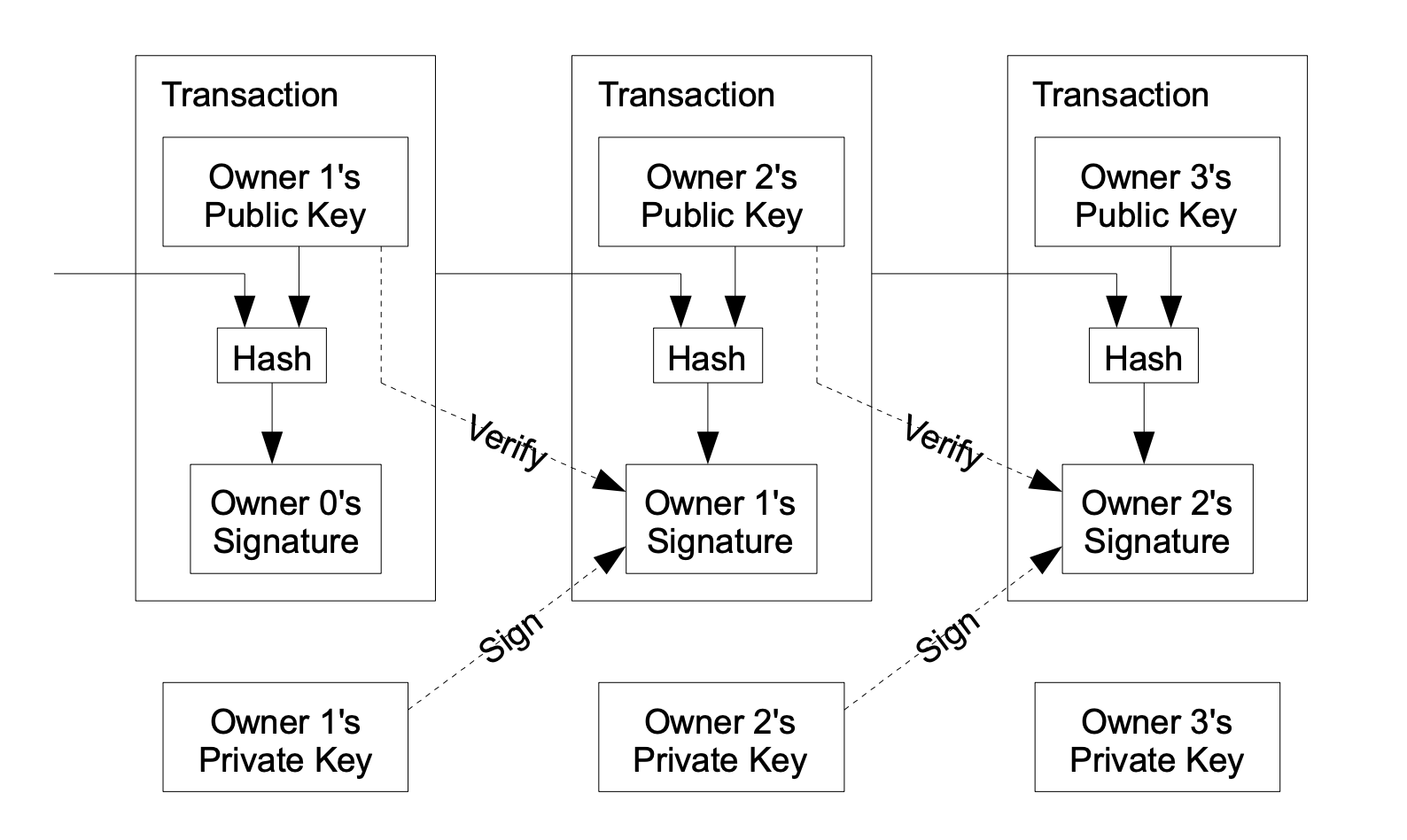
The problem of course is the payee can’t verify that one of the owners did not double-spend the coin. A common solution is to introduce a trusted central authority, or mint, that checks every transaction for double spending. After each transaction, the coin must be returned to the mint to issue a new coin, and only coins issued directly from the mint are trusted not to be double-spent. The problem with this solution is that the fate of the entire money system depends on the company running the mint, with every transaction having to go through them, just like a bank.
We need a way for the payee to know that the previous owners did not sign any earlier transactions. For our purposes, the earliest transaction is the one that counts, so we don’t care about later attempts to double-spend. The only way to confirm the absence of a transaction is to be aware of all transactions. In the mint based model, the mint was aware of all transactions and decided which arrived first. To accomplish this without a trusted party, transactions must be publicly announced 2, and we need a system for participants to agree on a single history of the order in which they were received. The payee needs proof that at the time of each transaction, the majority of nodes agreed it was the first received. [^ds/2024-08-19/3967f2ab8b78^]
3. Timestamp Server
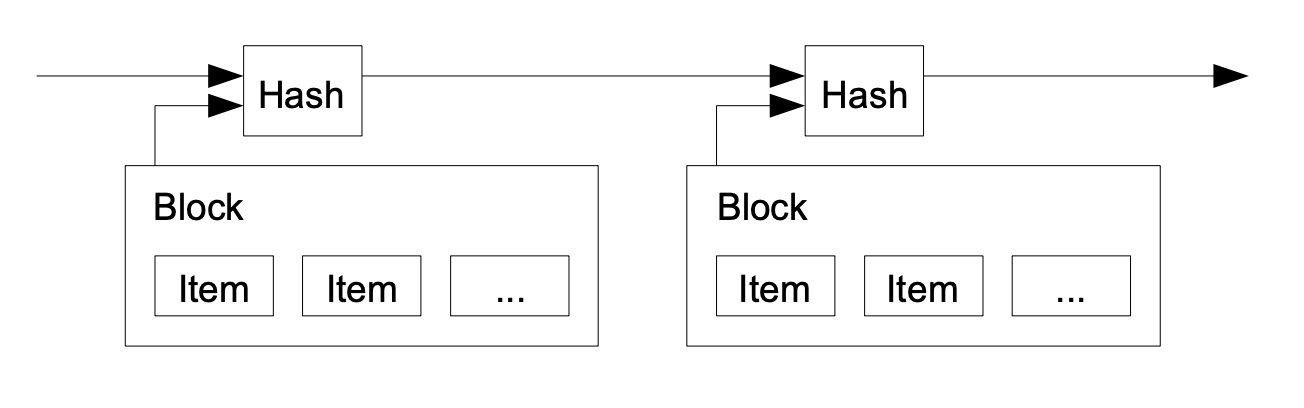
The solution we propose begins with a timestamp server. A timestamp server works by taking a hash of a block of items to be timestamped and widely publishing the hash, such as in a newspaper or Usenet post [2-5]. The timestamp proves that the data must have existed at the time, obviously, in order to get into the hash. Each timestamp includes the previous timestamp in its hash, forming a chain, with each additional timestamp reinforcing the ones before it. [^ds/2024-08-19/4fab248cf4b3^] ^ds-2024-08-19-b434aa848617
4. Proof-of-Work
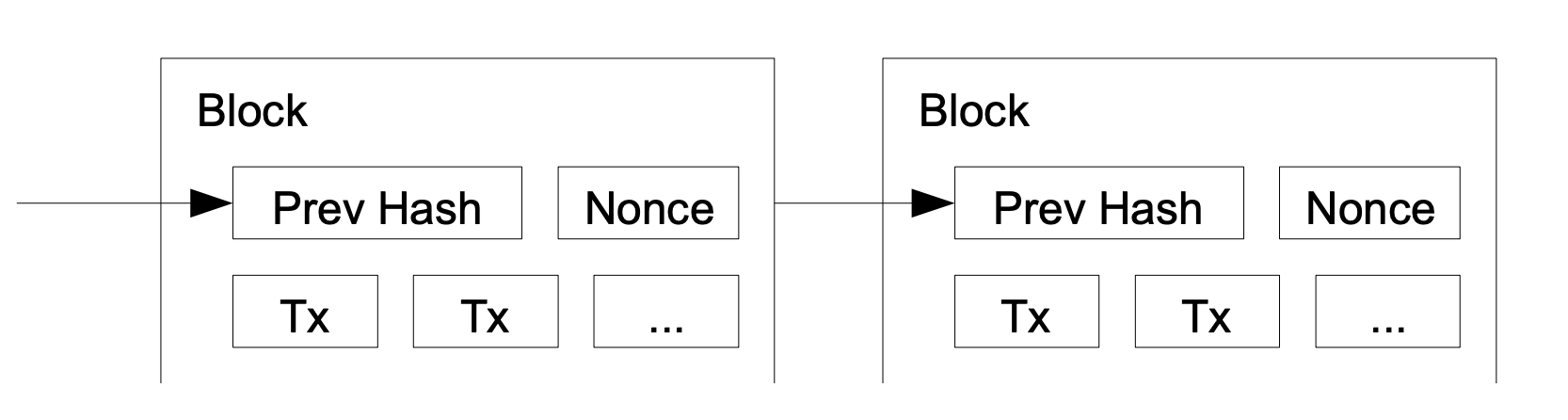
To implement a distributed timestamp server on a peer-to-peer basis, we will need to use a proofof-work system similar to Adam Back’s Hashcash 3, rather than newspaper or Usenet posts. The proof-of-work involves scanning for a value that when hashed, such as with SHA-256, the hash begins with a number of zero bits. The average work required is exponential in the number of zero bits required and can be verified by executing a single hash.
For our timestamp network, we implement the proof-of-work by incrementing a nonce in the block until a value is found that gives the block’s hash the required zero bits. Once the CPU effort has been expended to make it satisfy the proof-of-work, the block cannot be changed without redoing the work. As later blocks are chained after it, the work to change the block would include redoing all the blocks after it.
The proof-of-work also solves the problem of determining representation in majority decision making. If the majority were based on one-IP-address-one-vote, it could be subverted by anyone able to allocate many IPs. Proof-of-work is essentially one-CPU-one-vote. The majority decision is represented by the longest chain, which has the greatest proof-of-work effort invested in it. If a majority of CPU power is controlled by honest nodes, the honest chain will grow the fastest and outpace any competing chains. To modify a past block, an attacker would have to redo the proof-of-work of the block and all blocks after it and then catch up with and surpass the work of the honest nodes. We will show later that the probability of a slower attacker catching up diminishes exponentially as subsequent blocks are added.
To compensate for increasing hardware speed and varying interest in running nodes over time, the proof-of-work difficulty is determined by a moving average targeting an average number of blocks per hour. If they’re generated too fast, the difficulty increases. [^ds/2024-08-19/890619bdedb1^]
5. Network
The steps to run the network are as follows:
- New transactions are broadcast to all nodes.
- Each node collects new transactions into a block.
- Each node works on finding a difficult proof-of-work for its block.
- When a node finds a proof-of-work, it broadcasts the block to all nodes.
- Nodes accept the block only if all transactions in it are valid and not already spent.
- Nodes express their acceptance of the block by working on creating the next block in the chain, using the hash of the accepted block as the previous hash.
Nodes always consider the longest chain to be the correct one and will keep working on extending it. If two nodes broadcast different versions of the next block simultaneously, some nodes may receive one or the other first. In that case, they work on the first one they received, but save the other branch in case it becomes longer. The tie will be broken when the next proofof-work is found and one branch becomes longer; the nodes that were working on the other branch will then switch to the longer one.
New transaction broadcasts do not necessarily need to reach all nodes. As long as they reach many nodes, they will get into a block before long. Block broadcasts are also tolerant of dropped messages. If a node does not receive a block, it will request it when it receives the next block and realizes it missed one. [^ds/2024-08-19/b91872342ef6^]
6. Incentive
By convention, the first transaction in a block is a special transaction that starts a new coin owned by the creator of the block. This adds an incentive for nodes to support the network, and provides a way to initially distribute coins into circulation, since there is no central authority to issue them. The steady addition of a constant of amount of new coins is analogous to gold miners expending resources to add gold to circulation. In our case, it is CPU time and electricity that is expended.
The incentive can also be funded with transaction fees. If the output value of a transaction is less than its input value, the difference is a transaction fee that is added to the incentive value of the block containing the transaction. Once a predetermined number of coins have entered circulation, the incentive can transition entirely to transaction fees and be completely inflation free.
The incentive may help encourage nodes to stay honest. If a greedy attacker is able to assemble more CPU power than all the honest nodes, he would have to choose between using it to defraud people by stealing back his payments, or using it to generate new coins. He ought to find it more profitable to play by the rules, such rules that favour him with more new coins than everyone else combined, than to undermine the system and the validity of his own wealth. [^ds/2024-08-19/bd7459a0dd2c^]
7. Reclaiming Disk Space
Once the latest transaction in a coin is buried under enough blocks, the spent transactions before it can be discarded to save disk space. To facilitate this without breaking the block’s hash, transactions are hashed in a Merkle Tree 456, with only the root included in the block’s hash. Old blocks can then be compacted by stubbing off branches of the tree. The interior hashes do not need to be stored.
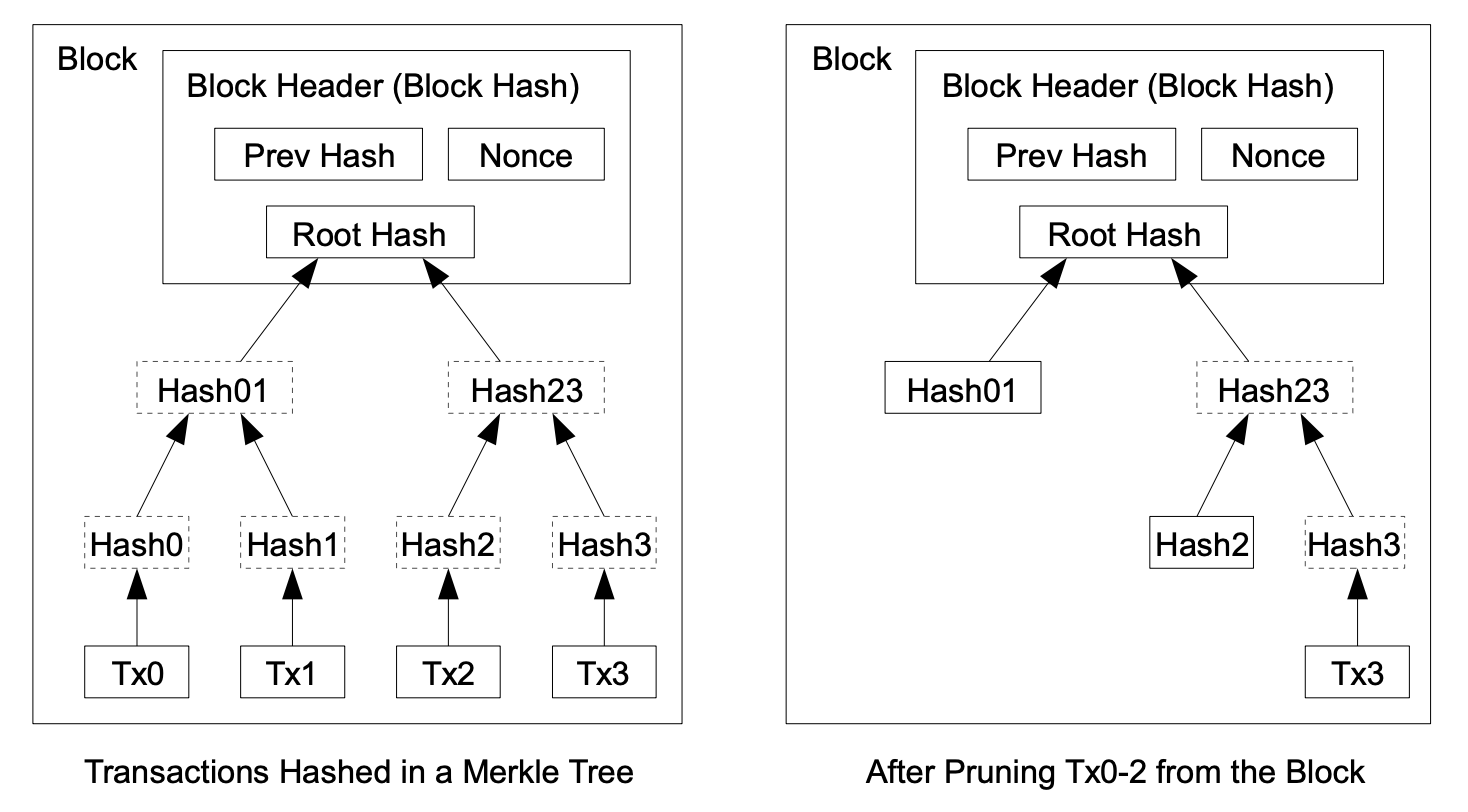
A block header with no transactions would be about 80 bytes. If we suppose blocks are generated every 10 minutes, 80 bytes * 6 * 24 * 365 = 4.2MB per year. With computer systems typically selling with 2GB of RAM as of 2008, and Moore’s Law predicting current growth of 1.2GB per year, storage should not be a problem even if the block headers must be kept in memory. [^ds/2024-08-19/fdc6b3befb1b^]
8. Simplified Payment Verification
It is possible to verify payments without running a full network node. A user only needs to keep a copy of the block headers of the longest proof-of-work chain, which he can get by querying network nodes until he’s convinced he has the longest chain, and obtain the Merkle branch linking the transaction to the block it’s timestamped in. He can’t check the transaction for himself, but by linking it to a place in the chain, he can see that a network node has accepted it, and blocks added after it further confirm the network has accepted it.
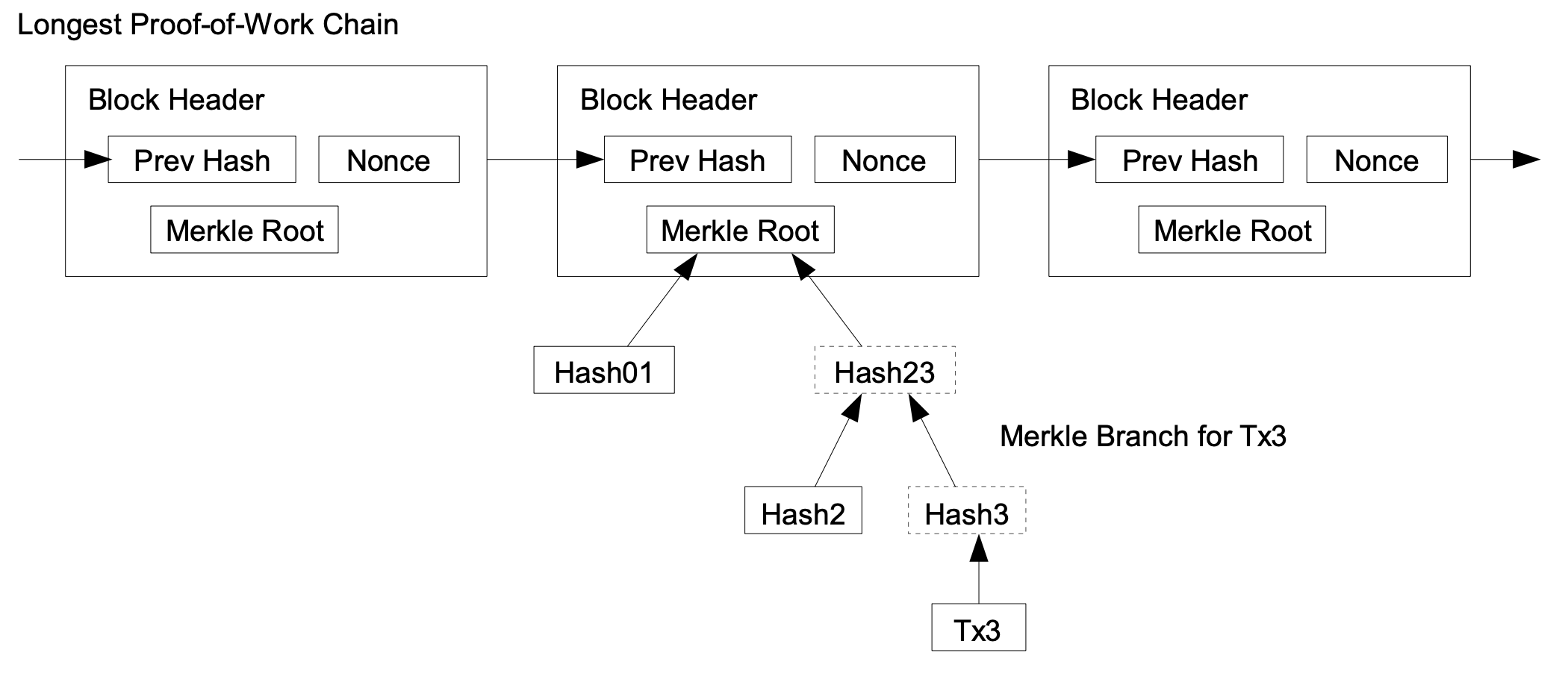 As such, the verification is reliable as long as honest nodes control the network, but is more vulnerable if the network is overpowered by an attacker. While network nodes can verify transactions for themselves, the simplified method can be fooled by an attacker’s fabricated transactions for as long as the attacker can continue to overpower the network. One strategy to protect against this would be to accept alerts from network nodes when they detect an invalid block, prompting the user’s software to download the full block and alerted transactions to confirm the inconsistency. Businesses that receive frequent payments will probably still want to run their own nodes for more independent security and quicker verification. [^ds/2024-08-19/f4245a13e08b^]
 9. Combining and Splitting Value
Although it would be possible to handle coins individually, it would be unwieldy to make a separate transaction for every cent in a transfer. To allow value to be split and combined, transactions contain multiple inputs and outputs. Normally there will be either a single input from a larger previous transaction or multiple inputs combining smaller amounts, and at most two outputs: one for the payment, and one returning the change, if any, back to the sender.
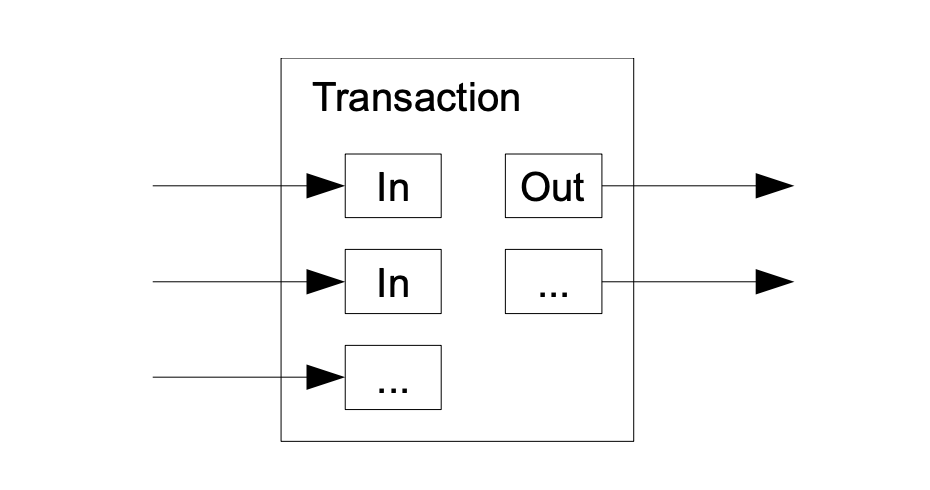
It should be noted that fan-out, where a transaction depends on several transactions, and those transactions depend on many more, is not a problem here. There is never the need to extract a complete standalone copy of a transaction’s history. [^ds/2024-08-19/4d7242b47323^]
10. Privacy
The traditional banking model achieves a level of privacy by limiting access to information to the parties involved and the trusted third party. The necessity to announce all transactions publicly precludes this method, but privacy can still be maintained by breaking the flow of information in another place: by keeping public keys anonymous. The public can see that someone is sending an amount to someone else, but without information linking the transaction to anyone. This is similar to the level of information released by stock exchanges, where the time and size of individual trades, the “tape”, is made public, but without telling who the parties were.
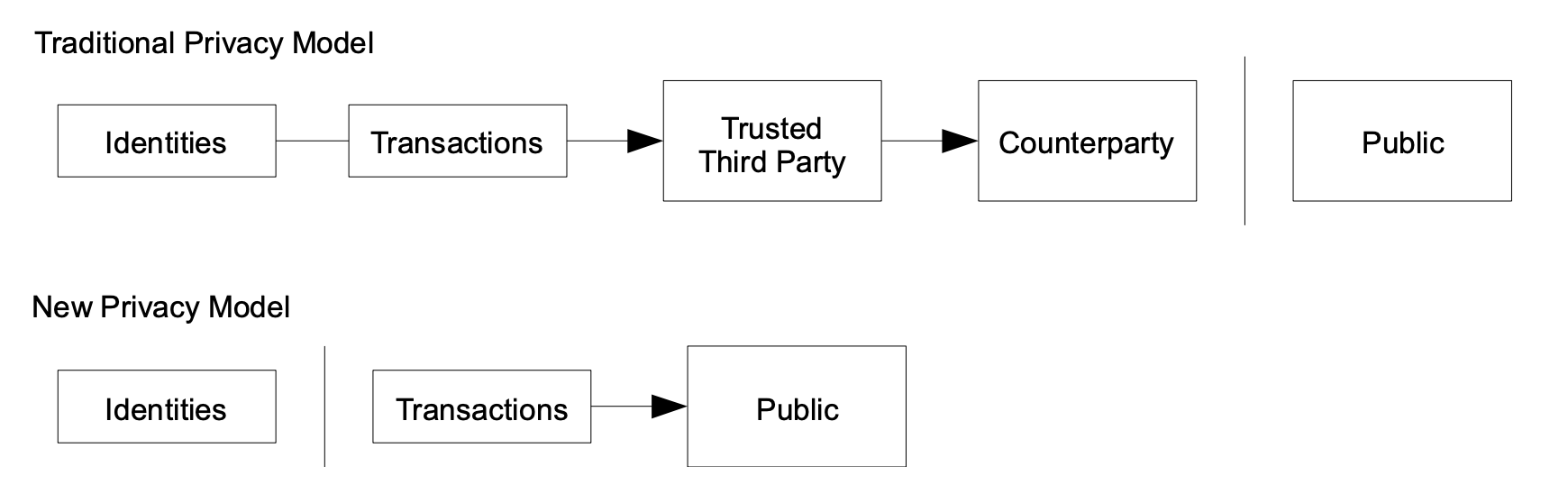
As an additional firewall, a new key pair should be used for each transaction to keep them from being linked to a common owner. Some linking is still unavoidable with multi-input transactions, which necessarily reveal that their inputs were owned by the same owner. The risk is that if the owner of a key is revealed, linking could reveal other transactions that belonged to the same owner. [^ds/2024-08-19/a1d2c37895fd^]
11. Calculations
We consider the scenario of an attacker trying to generate an alternate chain faster than the honest chain. Even if this is accomplished, it does not throw the system open to arbitrary changes, such as creating value out of thin air or taking money that never belonged to the attacker. Nodes are not going to accept an invalid transaction as payment, and honest nodes will never accept a block containing them. An attacker can only try to change one of his own transactions to take back money he recently spent.
The race between the honest chain and an attacker chain can be characterized as a Binomial Random Walk. The success event is the honest chain being extended by one block, increasing its lead by +1, and the failure event is the attacker’s chain being extended by one block, reducing the gap by -1.
The probability of an attacker catching up from a given deficit is analogous to a Gambler’s Ruin problem. Suppose a gambler with unlimited credit starts at a deficit and plays potentially an infinite number of trials to try to reach breakeven. We can calculate the probability he ever reaches breakeven, or that an attacker ever catches up with the honest chain, as follows 7:
- p = probability an honest node finds the next block
- q = probability the attacker finds the next block
- qz = probability the attacker will ever catch up from z blocks behind
- qz={ 1 if p≤q q/ p z if pq}
Given our assumption that p > q, the probability drops exponentially as the number of blocks the attacker has to catch up with increases. With the odds against him, if he doesn’t make a lucky lunge forward early on, his chances become vanishingly small as he falls further behind.
We now consider how long the recipient of a new transaction needs to wait before being sufficiently certain the sender can’t change the transaction. We assume the sender is an attacker who wants to make the recipient believe he paid him for a while, then switch it to pay back to himself after some time has passed. The receiver will be alerted when that happens, but the sender hopes it will be too late.
The receiver generates a new key pair and gives the public key to the sender shortly before signing. This prevents the sender from preparing a chain of blocks ahead of time by working on it continuously until he is lucky enough to get far enough ahead, then executing the transaction at that moment. Once the transaction is sent, the dishonest sender starts working in secret on a parallel chain containing an alternate version of his transaction.
The recipient waits until the transaction has been added to a block and z blocks have been linked after it. He doesn’t know the exact amount of progress the attacker has made, but assuming the honest blocks took the average expected time per block, the attacker’s potential progress will be a Poisson distribution with expected value:
- λ=zpq
To get the probability the attacker could still catch up now, we multiply the Poisson density for each amount of progress he could have made by the probability he could catch up from that point:
- ∑ k=0 ∞ k e − k! ⋅{ q/ p z−k if k≤z 1 if kz}
Rearranging to avoid summing the infinite tail of the distribution…
- 1−∑ k=0 z k e − k! 1−q/ p z−k
Converting to C code…
#include <math.h>
double AttackerSuccessProbability(double q, int z)
{
 double p = 1.0 - q;
 double lambda = z * (q / p);
 double sum = 1.0;
 int i, k;
 for (k = 0; k <= z; k++)
 {
 double poisson = exp(-lambda);
 for (i = 1; i <= k; i++)
 poisson *= lambda / i;
 sum -= poisson * (1 - pow(q / p, z - k));
 }
 return sum;
}
Running some results, we can see the probability drop off exponentially with z.
- q=0.1
- z=0 P=1.0000000
- z=1 P=0.2045873
- z=2 P=0.0509779
- z=3 P=0.0131722
- z=4 P=0.0034552
- z=5 P=0.0009137
- z=6 P=0.0002428
- z=7 P=0.0000647
- z=8 P=0.0000173
- z=9 P=0.0000046
- z=10 P=0.0000012
- q=0.3
- z=0 P=1.0000000
- z=5 P=0.1773523
- z=10 P=0.0416605
- z=15 P=0.0101008
- z=20 P=0.0024804
- z=25 P=0.0006132
- z=30 P=0.0001522
- z=35 P=0.0000379
- z=40 P=0.0000095
- z=45 P=0.0000024
- z=50 P=0.0000006
Solving for P less than 0.1%…
- P < 0.001
- q=0.10 z=5
- q=0.15 z=8
- q=0.20 z=11
- q=0.25 z=15
- q=0.30 z=24
- q=0.35 z=41
- q=0.40 z=89
- q=0.45 z=340 [^ds/2024-08-19/348971e798f5^]
12. Conclusion
We have proposed a system for electronic transactions without relying on trust. We started with the usual framework of coins made from digital signatures, which provides strong control of ownership, but is incomplete without a way to prevent double-spending. To solve this, we proposed a peer-to-peer network using proof-of-work to record a public history of transactions that quickly becomes computationally impractical for an attacker to change if honest nodes control a majority of CPU power. The network is robust in its unstructured simplicity. Nodes work all at once with little coordination. They do not need to be identified, since messages are not routed to any particular place and only need to be delivered on a best effort basis. Nodes can leave and rejoin the network at will, accepting the proof-of-work chain as proof of what happened while they were gone. They vote with their CPU power, expressing their acceptance of valid blocks by working on extending them and rejecting invalid blocks by refusing to work on them. Any needed rules and incentives can be enforced with this consensus mechanism. [^ds/2024-08-19/784b7820d873^]
References
Digests
Footnotes
-
Verified today! ↩
-
W. Dai, “b-money,” http://www.weidai.com/bmoney.txt, 1998. ↩
-
A. Back, “Hashcash - a denial of service counter-measure,” http://www.hashcash.org/papers/hashcash.pdf, 2002. ↩
-
R.C. Merkle, “Protocols for public key cryptosystems,” In Proc. 1980 Symposium on Security and Privacy, IEEE Computer Society, pages 122-133, April 1980. ↩
-
H. Massias, X.S. Avila, and J.-J. Quisquater, “Design of a secure timestamping service with minimal trust requirements,” In 20th Symposium on Information Theory in the Benelux, May 1999. ↩
-
S. Haber, W.S. Stornetta, “Secure names for bit-strings,” In Proceedings of the 4th ACM Conference on Computer and Communications Security, pages 28-35, April 1997. ↩
-
W. Feller, “An introduction to probability theory and its applications,” 1957. 9 [^ds/2024-08-19/eb4e05853840^] ↩
References
Footnotes
-
Sealed on 2024-08-24, Seal Hash: 31b180ada214, WC: 134, CC: 1061, File: DS Smart Paper DRAFT-3.md, Authors: Unknown ↩
-
2024-08-23T19:54:46.844Z WC:37, CC:249, DF:ba0e4d0ad18c.md ↩